
DepEd Memo
DepEd Introduces ILAW Lesson Planning: How TitserPlan Can Help Teachers Prepare Adaptive, AI-Assisted Lessons
DepEd Introduces ILAW Lesson Planning and guidelines in creating them.
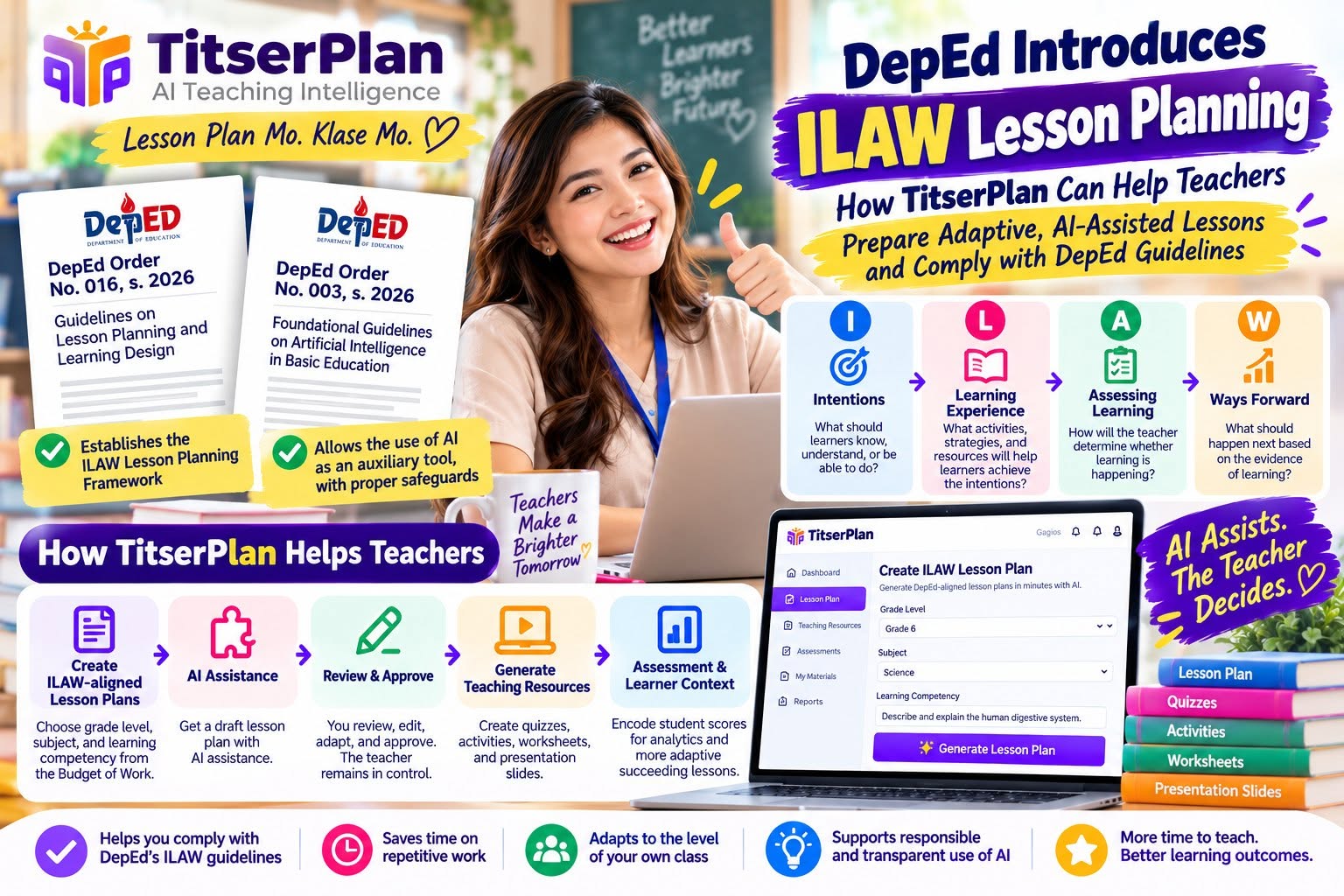
A new approach to lesson planning puts teacher judgment, learner context, assessment, and responsible use of AI at the center.
The Department of Education has introduced a significant change in lesson planning for Filipino teachers through DepEd Order No. 016, s. 2026, or the Guidelines on Lesson Planning and Learning Design, issued on June 4, 2026. The policy establishes a simplified and more learner-centered approach to lesson preparation built around the ILAW Framework. Department of Education
ILAW stands for four essential elements of lesson planning:
I — Intentions
What should learners know, understand, or be able to do?
L — Learning Experience
What learning experiences, activities, resources, and teaching strategies will help learners achieve those intentions?
A — Assessing Learning
How will the teacher determine whether learning is actually taking place?
W — Ways Forward
Based on the evidence of learning, what should happen next—remediation, reteaching, enrichment, adjustment, or progression?
This is more than a change in lesson-plan format. It shifts the emphasis from preparing paperwork to engaging in a continuing cycle of planning, teaching, assessing, reflecting, and improving instruction.
And this is exactly where technology such as TitserPlan can become useful.
AI Can Assist—But the Teacher Must Remain in Control
One of the most important features of the new DepEd policy is its treatment of Artificial Intelligence.
DepEd Order No. 016, s. 2026 works alongside DepEd Order No. 003, s. 2026, which provides the Department's foundational guidelines for AI in basic education. The AI policy recognizes uses of AI in lesson planning, instructional materials and assessment while requiring transparency, accountability and alignment with learning standards. Teachers are also directed to declare AI use in lesson-planning and assessment preparation.
preparation. Department of Education
But this does not mean that teachers should simply ask AI to make an entire lesson plan and submit the output.
The new lesson-planning policy preserves the teacher's professional judgment and pedagogical responsibility. AI is an auxiliary tool, not a replacement for the teacher. Third-party summaries of DO 016 report that fully AI-generated lesson plans without the necessary teacher judgment, validation and adaptation are not the intended model. iLaw Lesson Plan
That distinction is central to the way TitserPlan is designed.
TitserPlan: AI Assistance, Not AI Replacement
TitserPlan was designed around a simple principle:
AI assists. The teacher decides.
Instead of treating lesson planning as a one-click process where AI produces a generic lesson, TitserPlan can support the teacher through the different stages of lesson preparation.
The teacher first creates the class and identifies the appropriate grade level, subject and learning competency from the Budget of Work. The system can then provide AI assistance in developing the lesson around those instructional parameters.
But the process does not end when AI generates content.
The teacher reviews the lesson, edits it when necessary, adapts it to the class, and approves it before it becomes the teacher's lesson plan.
That distinction matters because DepEd's AI guidelines emphasize human oversight, validation and responsible AI use. Department of Education
From ILAW Lesson Plan to Teaching Resources
Lesson planning is also not an isolated activity.
Once a lesson has been prepared and approved, TitserPlan can help the teacher develop related instructional resources such as:
Quizzes • Activities • Worksheets • Presentation Slides
These resources can be linked to the lesson being taught rather than created independently without instructional context.
This helps maintain an important principle of ILAW: alignment.
The learning intentions, classroom experience and assessment should work together rather than exist as unrelated pieces of paperwork.
Where TitserPlan Becomes More Powerful: Learner Context
Perhaps one of the most important ideas behind the ILAW Framework is that a good lesson should respond to the actual learners in the classroom.
A lesson that worked perfectly for one Grade 6 class may not necessarily be appropriate for another Grade 6 class—even when both classes are covering the same competency.
Why?
Because learners are different.
Their prior knowledge, strengths, misconceptions, assessment results and learning difficulties can be different.
This is why TitserPlan includes an Assessment component.
After students take quizzes or assessments, teachers can record their results. Those results can contribute to the Learner Context used when preparing succeeding lessons.
The objective is to create a continuous instructional cycle:
Plan → Teach → Assess → Analyze → Adapt → Plan Again
That closely reflects the philosophy behind the “Ways Forward” component of ILAW: assessment evidence should help teachers determine what comes next for their learners.
Your Lesson Plan Should Not Simply Be Someone Else's Lesson Plan
This is another important difference.
For years, teachers under significant workload pressure have sometimes relied on downloadable lesson plans, shared files, or lesson-plan bundles prepared for other classrooms.
These materials can certainly serve as references. In fact, DepEd offices themselves have issued memoranda providing ILAW lesson exemplars and activity sheets as instructional references. DepEd SDO Bukidnon
But a reference lesson is not necessarily your lesson.
It may have been prepared for another teacher, another school and—most importantly—another group of learners.
TitserPlan takes a different approach.
Lesson Plan Mo. Klase Mo.
The teacher starts with the prescribed competency and creates the lesson for his or her own class. AI provides assistance, but the teacher reviews, modifies and approves the final lesson.
As assessment data accumulates, the opportunity to contextualize succeeding lessons becomes even stronger.
The goal therefore isn't simply to produce lesson plans faster.
The goal is to help teachers create better-informed lesson plans with less repetitive preparation work.
Responsible AI Use Still Matters
Teachers using TitserPlan—or any other AI-assisted tool—should also remember an important DepEd requirement: AI use must be disclosed when applicable.
DepEd Order No. 003, s. 2026 states that teachers should declare the use of AI tools in lesson planning and learning-assessment preparation, including learning activities and teaching materials. The guidelines also emphasize ethical use, privacy, verification and preservation of critical thinking and creativity. Department of Education
This presents an opportunity for TitserPlan to make responsible AI use easier rather than merely making content generation faster.
For example, an ILAW lesson plan generated with TitserPlan assistance can include an appropriate Declaration of AI Use, identifying TitserPlan as an AI-assisted tool and clarifying that the output was reviewed, validated, modified where necessary and approved by the teacher.
That would make transparency part of the workflow rather than an afterthought.
DepEd's direction toward simplified lesson planning and responsible AI use reflects a larger objective: technology should help teachers devote more of their time and professional energy to teaching and supporting learners.
DepEd offices are already conducting activities involving ILAW lesson planning and AI integration. For example, DepEd Region V's learning platform lists professional-development activities on strengthening ILAW lesson planning and using AI in education, while DepEd Caraga disseminated information on national online training on the ILAW Framework in September 2026. DepEd LMS
TitserPlan seeks to support that transition.
It doesn't replace the teacher.
It doesn't replace professional judgment.
And it shouldn't turn lesson planning into simply pressing a button and accepting whatever AI produces.
Instead, it can take care of some of the repetitive work so teachers can concentrate on what technology cannot replace:
Knowing their students. Making instructional decisions. Teaching. Assessing. Adapting. Inspiring.
AI assists. The teacher remains in control.
And with an adaptive approach to lesson planning, the lesson becomes more than a document submitted for compliance.
It becomes a living plan that changes as the class learns.
TitserPlan — Lesson Plan Mo. Klase Mo.